Monday, 2 July 2012

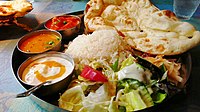
PUNJABI CUISINE


Other vegetarian dishes

  • Kadhi Pakora (Traditional curry with Pakoras) and rice
Kadhi is a type of curry made by cooking gramflour with curd or buttermilk. Fried lumps (Pakoras) of gramflour with salt and chillies are also added. It is eaten with rice.
  • Paneer dishes like Shahi Paneer, Khoya Paneer
  • Sweet dishes like Phirni, Jalebi, Malpua, Sheer korma
  • Snacks like Pakoras, Samosas

PUNJABI CUISINE

PUNJABI CUISINE


Vegetarian

Pulse, bean and/or lentil preparations:
  • sarson da saag (a dish prepared from green mustard leaves) and with makki di roti, a bread made by corn flour
  • mushroom and bean sabzi
  • Dal makhani (lentils with cream and butter)
  • rajma (red kidney bean) and rice
  • rongi (Black-eyed peas)
  • choley (eaten with naan or kulcha)

Punjabi Cusine


Punjabi cuisine  is food from the Punjab region of northwestern India and eastern Pakistan. It can be non-vegetarian or completely vegetarian. One of the main features of Punjabi cuisine is its diverse range of dishes. Home cooked and restaurant Punjabi cuisine can vary significantly, with restaurant style using large amounts of ghee, clarified butter, with liberal amounts of butter and cream, with home cooking concentrating on mainly upon preparations with whole wheat, rice and other ingredients flavored with masala.
Within the Punjab region, there are different preferences. People in the area of Amritsar prefer stuffed parathas and milk products. In fact, the area is well known for quality of its milk products. There are certain dishes which are exclusive to Punjab, such as sarson da saag. The main masala in a Punjabi dish consists of onion,garlic and ginger. Tandoori food is a Punjabi speciality especially for non-vegetarian dishes. Many of the most popular elements of Anglo-Indian cuisine - such as Tandoor, Naan, Pakoras and vegetable dishes with paneer - derive from the Punjab.

Sunday, 1 July 2012

Modern Varanasi


Banaras


Painting of Benares in 1890.

Modern history


After Aurangazeb’s death most of India was ruled by a confederacy of pro-Hindu kings. Much of modern Varanasi was built during this time by the Rajput and Maratha kings. The kings continued to be important through much of the British rule (1775–1947 AD), including the maharaja of Benares, or Kashi Naresh. The kingdom of Benares was given official status by the Mughals in 1737, and continued as a dynasty governed area up until Indian independence in 1947, during the reign of Dr. Vibhuti Narayan Singh. Benares was ceded to the Union of India on 15 October 1948. After the death of Dr. Vibhuti Narayan Singh in 2000, his son Anant Narayan Singh became the figurehead king of Benares, responsible for upholding the traditional duties of a Kashi Naresh.

KASHI NARESH :: KING OF BANARAS


Kashi Naresh and Ramnagar


Varanasi became an independent Kingdom of Kashi in the eighteenth century, and under subsequent British rule, it remained a commercial and religious centre. Varanasi suffered during the raids into India by Muhammad of Ghori. In 1910, the British made Varanasi a new Indian state, with Ramanagar as its headquarters but with no jurisdiction over the city of Varanasi itself. Kashi Naresh still resides in the fort of Ramanagar. The Ramnagar Fort of the Kashi Naresh is situated to the east of Varanasi, across the Ganges.The Ramnagar Fort was built by Kashi Naresh Raja Balwant Singh with creamy chunar sandstone in the eighteenth century. It is a typically Mughal style of architecture with carved balconies, open courtyards, and picturesque pavilions.The other fort of the Kashi Naresh is the Chet Singh Palace, near Shivala Ghat, Varanasi built by Maharaja Chet Singh.
A busy street in Varanasi, 2005
Ramnagar Fort and its museum are the repository of the history of the kings of Benares and since the 18th century has been the home of Kashi Naresh.Even today the Kashi Naresh is deeply revered by the people of Benares.. He is the religious head and some religious people of Benares consider him the incarnation of Lord Shiva.He is also the chief cultural patron and an essential part of all religious celebrations.

Varanasi/Banaras/Kashi


Etymology


The name Varanasi has its origin possibly from the names of the two rivers Varuna and Assi, for the old city lies in the north shores of the Ganges bounded by its two tributaries, the Varuna and the Assi, with the Ganges being to its south. Another speculation about the origin of the name is that the river Varuna itself was called Varanasi in olden times, from which the city got its name..This is generally disregarded by historians, though there may be some earlier texts suggesting it to be so.
Washerwoman at Varanasi, Along the Ganges
Through the ages, Varanasi was variously known as Avimuktaka, Anandakanana, Mahasmasana, Surandhana, Brahma Vardha, Sudarsana, Ramya, and Kasi..
In the Rigveda, the city was referred to as Kasi or Kashi, "the luminous one" as an allusion to the city's historical status as a centre of learning, literature, art and culture..Kasikhand described the glory of the city in 15, 000 verses in the Skanda Purana. In one verse, God Shiva says,
The three worlds form one city of mine, and Kashi is my royal palace therein.

Legendary history


According to legend, the city was founded by the Hindu deity Lord Shiva, several thousand years ago, thus making it one of the most important pilgrimage destinations in the country. It is also a general belief that it stands on the weapon "The Trishool" (Trident) of Lord Shiva. It is one of the seven sacred cities of the Hindus. Many Hindu scriptures, including the Rigveda, Skanda Purana, the Ramayana, and the Mahabharata, mention the city.
Varanasi is generally believed to be about 3000 years old..It is supposedto be the oldest city in the world, though Jericho also claims this title. Varanasi was an industry centre famous for its muslin and silk fabrics, perfumes, ivory works, and sculpture. During the time of Gautama Buddha (born circa 567 BCE), Varanasi was the capital of the Kingdom of Kashi. The celebrated Chinese traveller Xuanzang attested that the city was a center of religious and artistic activities, and that it extended for about 5 km along the western bank of the Ganges.

Varanasi :: The holy city of Hindu's

Varanasi ), also commonly known as Banaras or Benaras and Kashi), is a city situated on the banks of the River Ganges in the Indian state of Uttar Pradesh, 320 kilometres (199 mi) southeast of state capital Lucknow. It is regarded as a holy city by Hindus, Buddhists and Jains. It is one of the oldest continuously inhabited cities in the world and the oldest in India.
The Kashi Naresh (Maharaja of Kashi) is the chief cultural patron of Varanasi and an essential part of all religious celebrations.The culture of Varanasi is closely associated with the River Ganges and the river's religious importance. The city has been a cultural and religious centre in North India for several thousand years. The Benares Gharana form of the Indian classical music developed in Varanasi, and many prominent Indian philosophers, poets, writers, and musicians resided or reside in Varanasi. Gautama Buddha gave his first sermon at Sarnath located near Varanasi (Kashi).
People often refer to Varanasi as "the city of temples", "the holy city of India", "the religious capital of India", "the city of lights", "the city of learning", and "the oldest living city on earth."